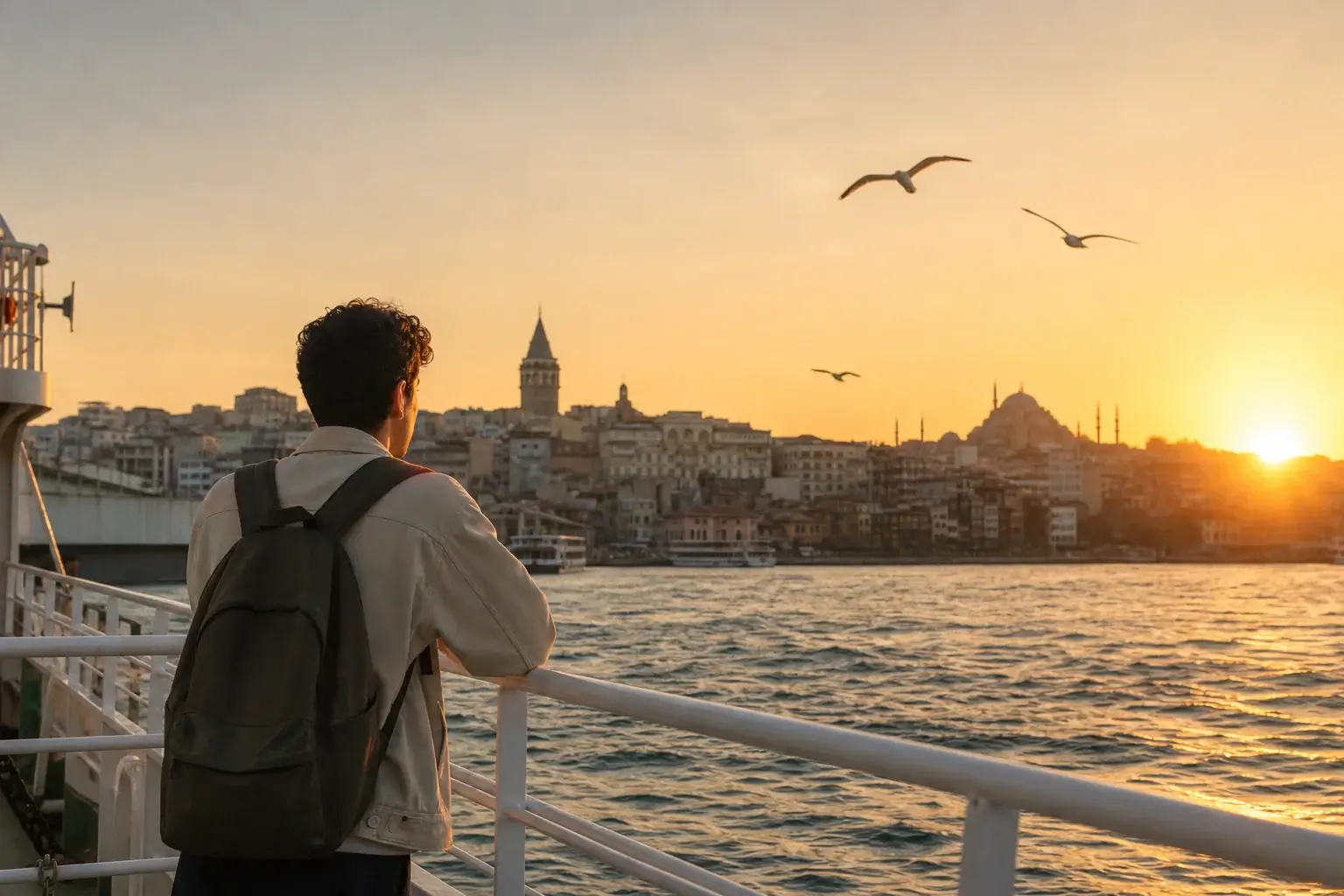
A flight to Canada can cost more than a semester of tuition in some Turkish cities. That math alone explains why Turkey has become one of the most talked-about study destinations among Algerian students, but the popularity hides a split most applicants discover too late: public and private universities admit students in completely different ways. This guide covers both routes, what they cost, and how to plan a realistic timeline.
Why Turkey appeals to Algerian students
A few reasons keep coming up when we talk to families weighing their options.
Proximity. Direct flights from Algiers or Oran to Istanbul take around three and a half hours, at fares usually well below a flight to Canada or the US. That matters for visits home and for parents who want to reach their child quickly if needed.
Lower cost of living. Rent, food, and transport in most Turkish cities are noticeably cheaper than in Paris, London, or Toronto, even accounting for currency swings. Turkey is not cheap in absolute terms, but the gap is real.
Cultural familiarity. For many Algerian families, Turkey feels culturally closer, from food to daily rhythm to the presence of mosques and halal options everywhere.
A real scholarship pathway. The Turkiye Burslari government scholarship (more below) is well known across Algeria and covers a meaningful share of costs for admitted students.
None of this makes Turkey automatically the right fit for everyone. Treat it as one serious option among several, not a default choice.
Public vs private universities: how admission actually differs
This is the part that trips up families, because the two tracks work very differently.
Public universities
Turkish public universities (Istanbul University, Ankara University, Middle East Technical University, and dozens of others) are generally the cheaper option, but admission for international students usually runs through one of two exam-based routes:
- YOS (Yabanci Uyruklu Ogrenci Sinavi), a university-specific exam testing maths and general reasoning rather than subject knowledge in Turkish.
- SAT or equivalent international exams, which a growing number of public universities accept instead of, or alongside, their own YOS.
Each university sets its own combination of accepted exams, minimum scores, and deadlines, so there is no single national process. Some also ask for a Turkish or English proficiency certificate depending on the medium of instruction.
Private universities
Private universities (Bilkent, Koc, Sabanci, Istanbul Aydin, and many others) generally use direct admission based on your Algerian bac results and transcripts, sometimes alongside an English score if the programme is taught in English. There is usually no YOS or SAT requirement, which makes the process faster, but tuition is significantly higher. And if you do not have a bac at all, some private universities admit through their own entrance exam instead, a route our guide to studying abroad without a bac walks through.
A side-by-side view
| Public universities | Private universities | |
|---|---|---|
| Admission route | YOS exam and/or SAT, set per university | Direct admission on bac transcript, plus English test if applicable |
| Typical tuition (per year) | Often lower, roughly in the low thousands of US dollars, varies widely by programme | Higher, from several thousand to well over ten thousand US dollars for competitive programmes |
| Application timeline | Exam dates and deadlines vary by university, often earlier | Rolling or semester-based, generally more flexible |
| Language of instruction | Mostly Turkish, some English-medium programmes | Frequently English-medium |
| Scholarship overlap | Eligible for Turkiye Burslari | Eligible for Turkiye Burslari and university-specific scholarships |
These are broad ranges, not quotes. Tuition and exam requirements change year to year and vary between universities, so always verify current numbers on the university's official site before deciding.
What it actually costs: tuition and living expenses
Be wary of anyone who gives you a single confident number for the cost of studying in Turkey. It depends heavily on the city, the university, and your own spending habits. As a general orientation as of 2026:
- Public tuition tends to sit in the lower range for most undergraduate programmes, while medicine, dentistry, and engineering cost more. Private tuition runs several times higher, particularly for English-medium business, engineering, and medical programmes.
- Rent varies enormously by city. A dormitory room or shared flat costs meaningfully less in Konya or Kayseri than in central Istanbul.
- Food, transport, and daily expenses in mid-sized cities are generally manageable on a modest budget, especially with a student transport card and cafeteria access.
- Health insurance is typically mandatory for international students and adds a modest annual cost.
Turkish inflation and currency movements have been significant in recent years, so costs that were true two years ago may not hold today. Treat any number here as a starting point to verify with the university's international office.
Turkiye Burslari: the government scholarship, at a glance
Turkiye Burslari is Turkey's flagship government scholarship for international students, and it is genuinely competitive rather than a formality. At a high level, it typically covers tuition, a monthly stipend, health insurance, and in many cases Turkish language preparation for students who need it.
A few honest points worth knowing:
- It is merit-based. Admission is not guaranteed by applying; the process involves an online application, document review, and often an interview.
- Application windows open and close on a fixed annual cycle, so missing it generally means waiting another year.
- Stipend amounts and eligibility change year to year, so do not plan your finances around a specific figure without checking the current cycle on the official site.
- Competition is high, which is why we recommend treating it as one part of a plan rather than the only plan.
Turkish-medium vs English-medium programmes
This choice affects almost everything else, from which universities are realistic options to how quickly you will feel settled academically.
Turkish-medium programmes are more common at public universities and usually require a year of intensive Turkish preparation (TOMER or equivalent) if you are not already proficient. That adds a year to your timeline but leaves you with strong Turkish, which helps with part-time work and daily life.
English-medium programmes are widely available, especially at private universities and in fields like business and engineering at public ones too. These usually require an English score (IELTS, TOEFL, or a university test) instead. Faster to start, but it can leave you more dependent on the international student bubble unless you build Turkish alongside your studies.
Neither path is objectively better. It comes down to how long you can spend preparing and what your longer-term plans look like.
Student life and the Algerian community
One of the more reassuring things about Turkey is that you are unlikely to be the only Algerian on campus. Istanbul, Ankara, and Konya in particular have visible Algerian and Maghrebi student communities, organised informally through WhatsApp and Telegram groups, student associations, and mosques near campuses.
Day to day, most students describe a familiar rhythm: shared flats or dormitories, cafeteria meals, part-time work where visa rules allow it, and affordable weekend trips thanks to Turkey's domestic transport network. Halal food is the default rather than an exception.
That said, homesickness and adjustment challenges are real everywhere. Bureaucracy around residence permits and university paperwork can be slow and inconsistent between offices, so patience and organised documentation go a long way.
Residence permit basics
Every international student staying beyond the visa-exempt period needs a residence permit, known locally as ikamet. In broad terms, the process involves:
- Applying online through Turkey's e-ikamet system, within the window your university specifies after enrollment.
- Submitting proof of enrollment, health insurance, proof of accommodation, and passport photos.
- Attending an appointment or submitting documents at the relevant provincial migration office.
- Renewing the permit annually for the duration of your studies.
Processing times and document lists shift periodically. University international offices are usually your best and most current source, since they handle this for hundreds of students every intake.
Building a realistic timeline
A common mistake is starting the process two or three months before the intended intake. For Turkey, especially with Turkiye Burslari or a Turkish-medium public programme in the mix, a longer runway makes things much less stressful.
- Ten to twelve months before: research universities, shortlist based on public vs private and language of instruction, and check whether Turkiye Burslari's window aligns with your target start date.
- Eight to ten months before: prepare documents (transcripts, bac certificate, passport, language test results if needed), and register for YOS or SAT where required.
- Six to eight months before: submit university applications, apply to Turkiye Burslari if the window is open, and start language preparation for a Turkish-medium track.
- Three to five months before: receive admission decisions, confirm funding, and begin the student visa application at the Turkish consulate.
- One to two months before: finalise accommodation, health insurance, and travel, and prepare documents for your residence permit application.
Exam dates, scholarship deadlines, and consulate processing times shift year to year, so treat this as a framework, not a fixed calendar, and cross-check current dates against the university and Turkiye Burslari's official pages.
Getting the details right for your situation
Turkey offers a genuinely strong combination of affordability, proximity, and cultural familiarity, but the public versus private decision, the exam requirements, and the scholarship timeline interact in ways that are easy to get wrong on your own. A wrong exam registration or a missed scholarship window can cost you an entire year.
Fennec360 has helped Algerian students work through exactly this kind of planning for Turkey, from choosing between YOS and SAT routes to building a realistic budget and timeline. See how we support applications to Turkey on our study abroad in Turkey service page, or get in touch to talk through your specific situation.
Keep reading

How to Apply for an Ausbildung from Algeria
Where you register, how you apply to a company, the documents, the German embassy visa file and appointment in Algiers, step by step with official sources.

TCF vs TEF (2026): Which French Exam Do You Actually Need?
Study in France, immigrate to Canada, apply to Quebec, or naturalize: which exam and which version fits your goal, and how scores convert to CLB. A clear map for Algerians.
Want the next one in your inbox?
One email when we publish something worth reading. Visa changes, deadlines, honest advice. Nothing else.